Market Outlook
Market Outlook

| July 2026 |
|

|
Amongst global markets, sell-off in Artificial Intelligence (AI) theme, led to sharp decline in South Korean market, with KOSPI down by 22.2% for the month, followed by Japan’s NIKKEI 225 (-8.1%) and Taiwan Index (-6.5%). Chinese index SSE Composite (Shanghai Stock Exchange) was also down by 6.4% in July. Hong Kong’s Hang Seng Index rallied the most amongst Asian markets, up by 13.1% driven by healthy earnings expectations and rally in some of the key tech stocks.
Amongst developed European economies, FTSE 100 Index (UK) was up by 3.5%, followed by German index DAX (+2.5%) and French CAC 40 (+1.3%). US index Dow Jones was up by 0.4% driven by corporate earnings and sector rotation away from tech stock, while S&P 500 was down by 0.2% on account of selling in semiconductor and AI stocks and escalation in US-Iran war.
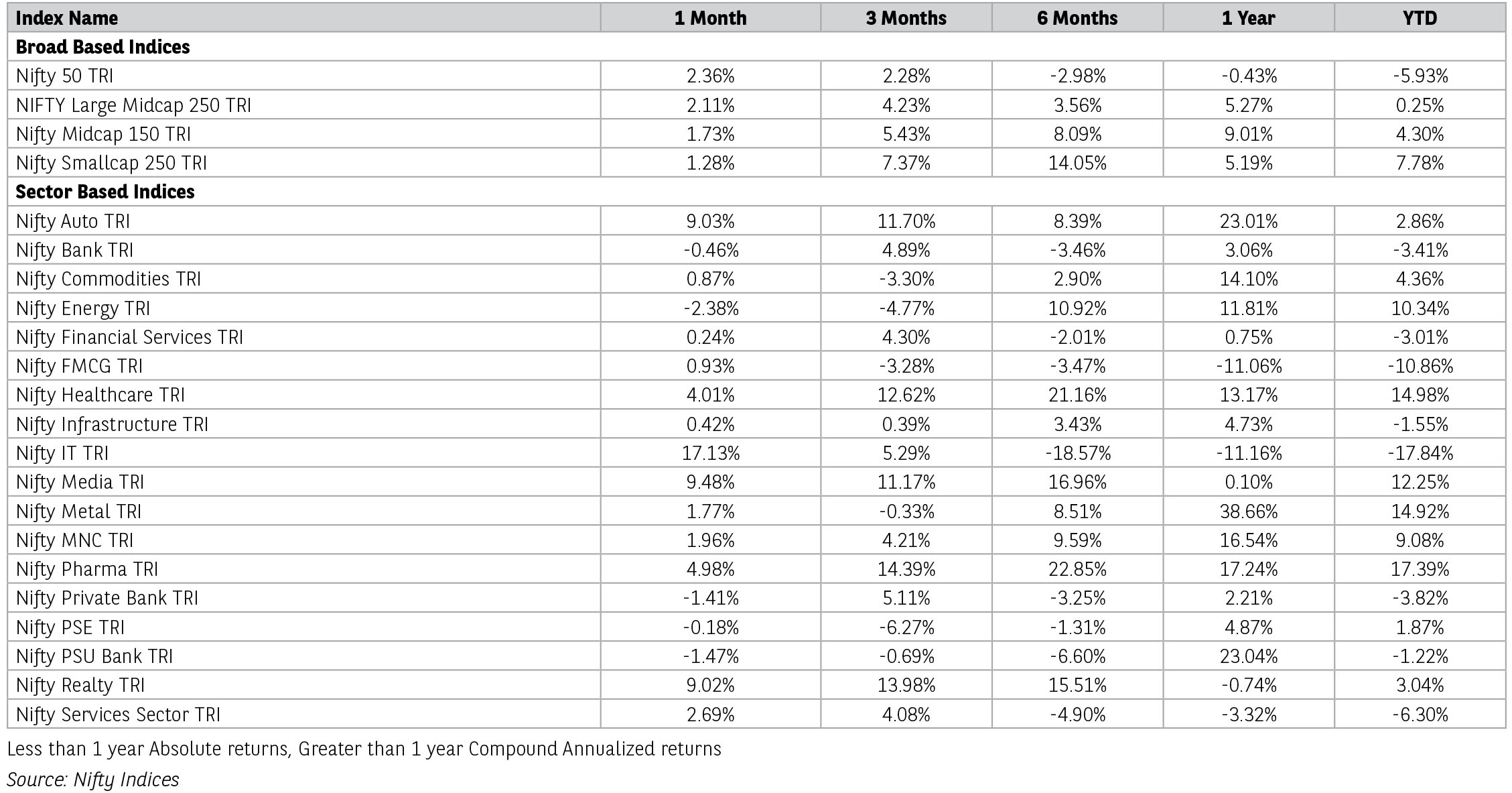
During the month, mid and small cap index, although positive, underperformed the broader market with Nifty Midcap 150 Index up by 1.6 and Nifty Small Cap 250 Index by 1.1%. Within sectoral IT index saw the highest rally with BSE IT up by 14.7%, followed by BSE Consumer Durables (+9.3%), BSE realty (+8.6%), BSE Consumer discretionary (+3.9%), BSE Healthcare (+3%), BSE Metals (1.8%) and BSE Oil (1.7%). BSE Cap goods saw the most fall during the month, down by 5.4% and BSE Banks by 0.2%.
After four consecutive months of net outflows, Foreign institutional investors have turned positive with net inflows of USD 2.3bn on account of attractive valuations, improving corporate earnings and switch from AI and semiconductor theme from South Korea and Taiwan. Amongst emerging economies, South Korea and Taiwan saw second consecutive month of intense selling to the tune of USD 6.2bn and USD 23.3bn respectively in July 2026. Thailand saw inflows of USD 1.5bn, followed by Brazil (+USD 639mn).
After the news of temporary halt in the West Asia crisis, tensions have again erupted with both US and Iran resuming attacks. This also led to crude oil prices inching up back to USD 92-93/barrel levels at the start of July amid supply disruption worries and settling at around USD 85/barrel. The Strait of Hormuz has not yet fully opened up, and traffic has drastically reduced leading to volatility in crude oil prices.
After the US Supreme Court struck down his tariff policy, President Trump had imposed temporary 150-day 10% global import duty. This is now replaced by new Section 301 with duties ranging from 10-12.5% on 60 countries. In the recently concluded US Fed meeting, the committee held the interest rates steady at 3.5-3.75% amid heightened inflationary pressure. The Fed Chair Kevin Warsh pledged to reduce the inflation to 2% from current 3.5% level. The International Monetary Fund (IMF), in its July World Economic Outlook Update, revised its global growth forecast downwards by 10bps to 3% from 3.1% in April 2026. Global headline inflation is expected to rise from 4.1% in 2025 to 4.7% in 2026, reflecting persistent price pressure arising from supply side constraints.
Locally, corporate India has started reporting its Q1FY27 results. 39 of the Nifty 50 companies have reported results ahead of expectation. Results for the banking sector were a mixed bag. Growth remains very strong across the sector however, skewed towards corporate and business banking. In terms of margins, large banks faced margin pressure arising because of change in asset mix while, few smaller and PSU banks surprised on margin expansion. For the IT sector, demand continues to remain cautious, although expected to improve in coming quarters. AI led productivity continued to compress deal sizes. FMCG sector delivered a steady Q1FY27, with price-led growth returning after a two-year gap.
Manufacturing activities slowed down marginally from 55 in May to 54.2 in June. Growth slowed across output, new orders, exports orders and employment, with international sales recording their weakest increase since March 2023. Services PMI also eased to 57.4 in June 2026 from 59.8 in May 2026, lowest in 17 months. Retail inflation rose to 4.38% in June from 3.93% in previous months, primarily led by increase in food inflation from 4.6% to 5.05%.
Cumulative rainfall was 13% below long-term average till 31st July. On a cumulative basis, rainfall was deficient in east, northeast and south India while rainfall was normal in central and northwest India. El Nino conditions have strengthened.
While result season has started on a positive note, concerns over inflation and profitability in 2HFY27 on account of West Asia war has again emerged as there are no clear signs of the crisis ending. Also progress of monsoon will be key monitorable with regards to impact on food inflation. Trailing Nifty valuations have now reverted to lower than the historical average to a PE of 21.8x as compared to its long term average of 23.2x.
Source: Kotak Securities/Capital 360 ONE, Motilal Oswal Securities, Industry reports. Data as on July 31, 2026.
The global economy continues to navigate heightened uncertainty amid fragile geopolitical conditions and persistent supply-chain pressures. The breakdown of ceasefire talks in West Asia has once again disrupted global supply chains, threatening to reverse the fragile recovery seen in recent months. Expectations of easing tensions in West Asia through June helped stabilize financial markets and improve business sentiment; however, the collapse of the peace arrangement in early July has once again heightened uncertainty around the outlook for global trade and inflation.
Commodity prices had moderated through the period, with crude oil, natural gas, fertilizers and industrial metals largely retracing towards their pre-conflict levels by early July. However, the renewed escalation in West Asia has once again increased uncertainty in energy markets, leading to a firming in crude oil prices and raising concerns around the persistence of global inflationary pressures.
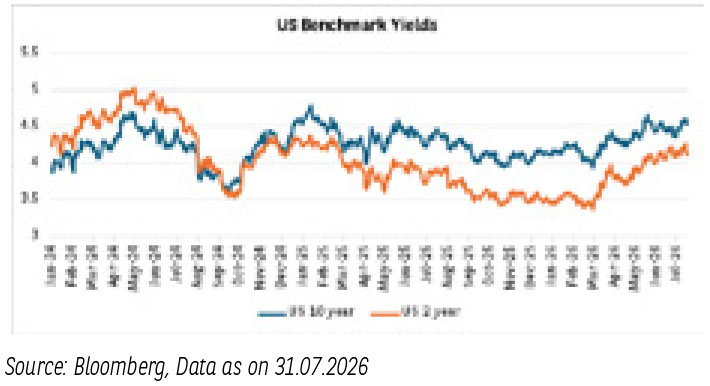
The US 10-year Treasury yield remained elevated through June and hardened further in early July amid expectations of a tighter monetary policy stance. However, yields subsequently eased following softer-than-expected inflation data. Against this backdrop, central bank policy responses remained divergent across economies, reflecting differences in the evolving growth-inflation dynamics and the varying impact of geopolitical and supply-side developments.
In its July 2026 update to the World Economic Outlook, the IMF revised its global growth projection for 2026 downward by 10 basis points compared with its April 2026 forecast, reflecting the adverse impact of the West Asia conflict, partly offset by stronger investment related to AI. Global growth is projected to improve in 2027, although the pace of recovery is expected to remain uneven across economies. Global headline inflation is projected to rise to 4.7% in 2026 from 4.1% in 2025 before moderating to 3.9% in 2027. Overall, risks to the global growth outlook remain tilted to the downside, with renewed tensions in West Asia, disruptions to global supply chains and persistent inflationary pressures continuing to pose key risks.
Central banks maintained a cautious but divergent approach to monetary policy during June, with policy decisions continuing to reflect differences in domestic growth and inflation dynamics. Against a backdrop of rising inflationary pressures, the Euro area and Japan raised policy rates and signaled the possibility of further monetary tightening.
Domestic Economy-
Within the span of a week starting July-2026 India’s economy is witnessing volatile movements in economic variables, impacting the outlook for the Indian economy and once again highlighting how increasingly contingent it has become on the evolving geopolitical situation surrounding the US-Iran conflict, evolving monsoon and El Nino conditions and domestic financial and regulatory developments. As geopolitical developments reshape crude oil prices and global risk sentiment, expectations for inflation, currency, trade, and the overall economic outlook continue to evolve. Current domestic high frequency indicators reflect buoyant economic activity. Industrial activity remained robust and the services sector showed resilience, supported by pick-up in urban demand.
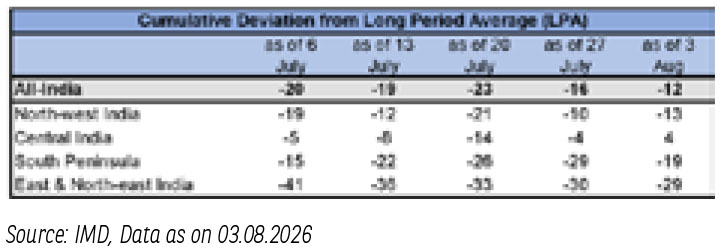
Domestic demand was also supported by a sharp pick-up in rural demand in June. Tractor sales accelerated with the commencement of kharif sowing activities, while two-wheeler sales recorded robust growth. Monsoon activity also showed pickup in rainfall. The South-West monsoon picked up momentum in July after a delayed start in June, resulting in the cumulative rainfall deficit narrowing to 12% (from the Long Period Average) till August 03, 2026. Region-wise, the highest deficit is in East and North East (29%) and South Peninsula (19%). The other regions recorded normal rainfall.
Improvement in rainfall activity has resulted in a pick-up in kharif sowing, which is now tracking marginally below last year by 3.6% YoY as of July 31. Reservoir levels remain below last year (65% of last year's level) and the 10-year average (93% of the 10-year average) as of July 30, 2026.
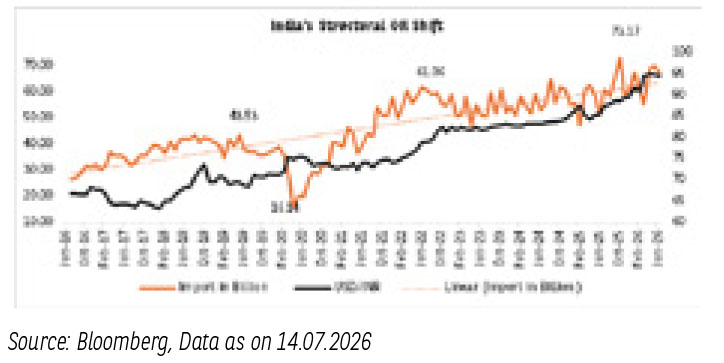
The merchandise trade deficit widened to a five-month high in June 2026 and increased on a year-on-year (y-o-y) basis. The higher trade deficit was driven by oil and electronic goods, with the deficit on account of electronics goods nearly doubling over the previous year.
Domestic Inflation-
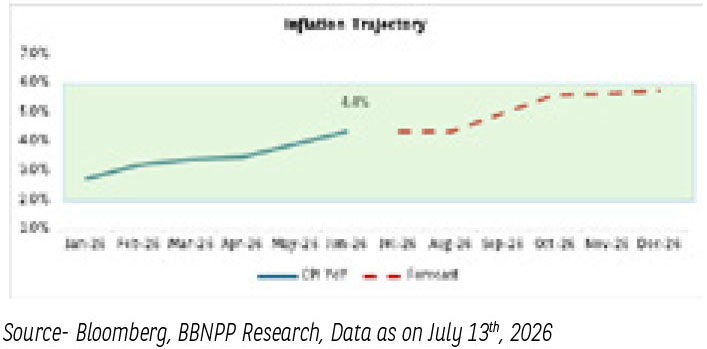
- Headline CPI accelerated to 4.4% y/y in June-2026 vs 3.9% in May-2026.
- The increase was primarily driven by higher food prices and the gradual pass-through of war-induced increases in global energy prices and transportation costs.
- Food CPI accelerated to 5.1% y/y in June-2026 from 4.5% in the prior month, driven by higher prices across the board.
- Core CPI remained steady at 3.9% y/y in June-2026 for the second month in a row.
- Within core inflation, the uptick was led by higher inflation in restaurant services, education, furnishings & household equipment and clothing & footwear.
Fixed Income Outlook –
During the month, fixed income rates witnessed swings led by news flows both positive and negative. The ceasefire between US and Iran brought softening of rates as commodity prices declined.
Inflation and Monetary Policy:
India's fixed-income market entered July with a more cautious backdrop as CPI inflation rose to 4.38% in June from 3.93% in May, moving above the RBI's 4% target. The increase was driven largely by food and fuel-related pressures, with the monsoon and global commodity prices emerging as key variables for the inflation trajectory.
The RBI in August-2026 policy is expected to retain the repo rate at 5.25%, while noting recent rise in inflation. The policy is expected to be forward looking and also take into consideration recent pickup in monsoon and an elevated, but range bound crude. We therefore see the monetary policy stance remaining data-dependent, with the RBI likely to prioritize inflation management while retaining flexibility to support growth should external risks weigh materially on domestic activity.
Liquidity and Bond Market:
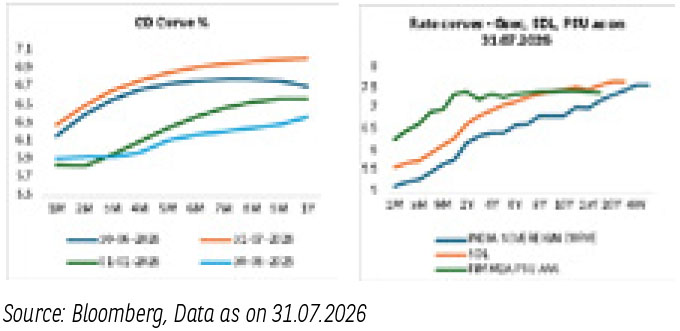
Domestic liquidity conditions remain broadly supportive, although the RBI continues to actively manage liquidity through its market operations. The central bank's June measures to encourage foreigncurrency inflows, including the special FCNR(B) deposit and swap facility, have also helped improve the external liquidity environment. At the same time, government borrowing and elevated global yields continue to act as constraints on the long end. The 10-year benchmark remained around the 6.8% level through July, reflecting the balance between supportive domestic liquidity and concerns around inflation, crude oil and global rates. We expect liquidity to remain an important support for the front end, but believe the long end will continue to trade with a higher risk premium.
INR, FCNR(B) Flows and External Sector:
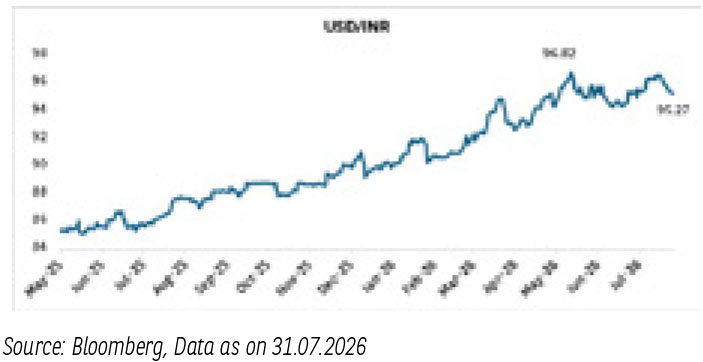
The INR remained under pressure through July-2026, while showing some appreciation around end of the month. The currency came under pressure from the sharp increase in crude prices amid geopolitical tensions, higher corporate dollar demand and concerns around India's oil-import dependence. However, the depreciation was relatively contained due to capital inflows and RBI intervention. The RBI's special FCNR(B) deposit swap facility, announced in June and available for fresh/renewed deposits mobilised between June 8 and September 30, has emerged as an important source of foreign-currency liquidity. Banks had mobilised around $32 billion under the facility by mid-July, providing a meaningful cushion to the balance of payments and reducing near-term pressure on the INR. Importantly, the FCNR(B) flows are supportive for the currency and external liquidity, but do not eliminate the structural sensitivity of the INR to crude prices. A sustained rise in oil prices would still remain a risk to INR.
G-Sec Curve: Front End Outperforms Long End:
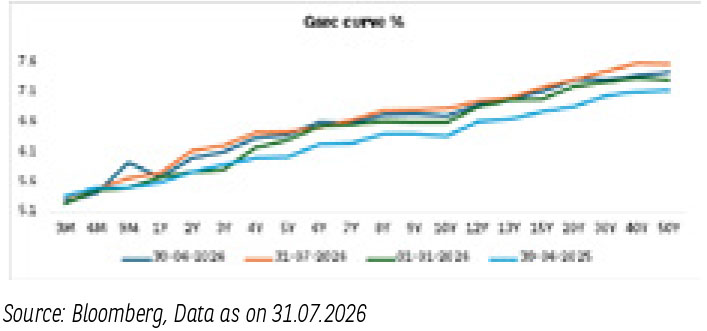
The G-sec curve saw considerable volatility during July, with the short end benefiting from expectations of easier liquidity and the RBI's measures to attract foreign currency inflows, while the long end remained more vulnerable to inflation, crude and global yield risks. The 2-year yield moved from around 5.97% at the beginning of July to around 5.92% towards month-end, while the 10-year yield ended July at approximately 6.83%, resulting in a relatively steep curve. The long end also faced pressure from the sharp rise in crude prices and the uncertainty around foreign demand for Indian government bonds. Foreign investors had turned net sellers of FAR bonds towards the end of July after strong inflows earlier in the month, while Bloomberg's decision to defer India's inclusion in its Global Aggregate Index added another near-term headwind. Overall, the curve continues to reflect a divergence between a relatively well-supported front end and a long end that demands a higher risk premium for inflation, fiscal and external-sector risks.
Outlook:
Our view on Indian fixed income remains constructive but duration selective. The combination of relatively comfortable domestic liquidity, the RBI's willingness to support financial conditions and the potential for inflation to moderate once temporary food and energy pressures fade remains supportive for bonds. However, the riskreward for aggressive duration positioning has become less attractive given the rise in crude prices, INR sensitivity and uncertainty around global yields. We therefore prefer carry and selective duration, with greater comfort towards the belly of the curve rather than taking significant exposure at the long end. A moderation in crude prices, normalization in food inflation and continued foreign inflows could provide room for yields to rally, while a sustained oil shock or further INR weakness would pose upside risks to yields. In our base case, we expect the 10-year G-sec to remain range-bound around current levels, with the next meaningful directional move dependent on the evolution of inflation, crude prices and the RBI's policy response.
The material contained herein has been obtained from publicly available information, believed to be reliable, but Baroda BNP Paribas Asset Management India Private Limited (BBNPPAMIPL) makes no representation that it is accurate or complete. This information is meant for general reading purposes only and is not meant to serve as a professional guide for the readers. This information is not intended to be an offer to see or a solicitation for the purchase or sale of any financial product or instrument. Past Performance may or may not be sustained in future and is not a guarantee of future returns.
Disclaimers for Market Outlook - Equity: The views and investment tips expressed by experts are their own and are meant for informational purposes only and should not be
construed as investment advice. Investors should check with their financial advisors before taking any investment decisions.
The material contained herein has been obtained from publicly available information, internally developed data and other sources believed to be reliable, but Baroda BNP
Paribas Asset Management India Private Limited (BBNPP), makes no representation that it is accurate or complete. BBNPP has no obligation to tell the recipient when opinions
or information given herein change. It has been prepared without regard to the individual financial circumstances and objectives of persons who receive it. This information is
meant for general reading purposes only and is not meant to serve as a professional guide for the readers. Except for the historical information contained herein, statements in
this publication, which contain words or phrases such as ‘will’, ‘would’, etc., and similar expressions or variations of such expressions may constitute forward-looking statements.
These forward-looking statements involve a number of risks, uncertainties and other factors that could cause actual results to differ materially from those suggested by the
forward-looking statements. BBNPP undertakes no obligation to update forward-looking statements to reflect events or circumstances after the date thereof. Words like believe/
belief are independent perception of the Fund Manager and do not construe as opinion or advice. This information is not intended to be an offer to see or a solicitation for the
purchase or sale of any financial product or instrument. The investment strategy stated above is for illustration purposes only and may or may not be suitable for all investors.